
The dryer is arguably the most underappreciated item in a home grooming kit. Owners will spend money on high-quality shampoo, a good set of brushes, and clippers. After that, they will either point a human hair dryer at their pet and cross their fingers or dry it with a bath towel and hope for the best.
The issue is that air-drying (or towel-drying alone) isn’t simply slower; for many pets, particularly long-haired or double-coated breeds, it actively undermines all the other goals of a home grooming regimen.
What Actually Goes Wrong When a Pet Air-Dries
The dryer is arguably the most underappreciated item in a home grooming kit. Owners will spend money on high-quality shampoo, a good set of brushes, and clippers. After that, they will either point a human hair dryer at their pet and cross their fingers or dry it with a bath towel and hope for the best.
The issue is that air-drying (or towel-drying alone) isn’t simply slower; for many pets, particularly long-haired or double-coated breeds, it actively undermines all the other goals of a home grooming regimen.
- Matting: Any loose hair left over after a bath can be felt into mats as it dries because wet undercoat fur tangles and clumps far more readily than dry fur.
- Hot spots and skin irritation: Prolonged moisture against the skin, particularly in warm weather, fosters the growth of germs and yeast.
- After the bath, a musty “wet dog” odour that persists for hours or even a whole day.
- A somewhat longer route to a finished, brushed-out coat since, in most cases, a coat that is still damp below cannot be adequately de-shed or brushed out.
All of this is resolved by a good pet dryer, which quickly and uniformly forces warm (or cool) air through the coat, drying both layers at nearly the same rate.
Why “Just Use a Human Hair Dryer” Doesn’t Really Work
Although it’s a popular shortcut, human hair dryers are designed for a completely different purpose:
They operate at temperatures higher than those safe for extended contact with animal skin, which is more sensitive to heat than human scalp skin.
Their concentrated, narrow airflow works well for styling human hair, but it is ineffective for forcing air through a thick double coat.
They are noisy in a way that is particularly annoying to dogs; the steady hum of a pet-specific dryer seems to cause less anxiety than the pitch and irregularity of a human dryer’s motor.
Wider airflow nozzles, motors adjusted to run at a steadier, less alarming pitch, and lower, animal-safe heat settings (many operate cool-air-only or low-heat by default) are all features of pet dryers.
What’s New in Home Pet Dryers This Year
The loud, high-velocity “force dryers” used by professional groomers in salons have given way to smaller, quieter models intended for home usage. The following characteristics are most prevalent in the most recent generation of household dryers:
Ionic or negative-ion airflow — marketed to reduce static and frizz, and to cut drying time by breaking water molecules down faster.
Multiple heat and speed settings, including a cool-air-only mode for anxious pets, puppies, or hot climates.
Noise levels closer to a standard hair dryer rather than the much louder salon-grade force dryers, making them far more tolerable for sound-sensitive pets.
Compact, lightweight bodies designed to be held one-handed for 15–20 minutes without fatigue, or mounted on a stand for hands-free use.
How to Choose One for Home Use
- Verify the decibel level. In a confined washroom, salon force dryers can operate at over 90 dB, which is quite uncomfortable for you and your pet. Seek out household models that are louder than 70 dB.
- Look for heat adjustment options, such as a no-heat setting. This allows you to adapt to changing seasons and household pets.
- Give airflow (CFM) more weight than raw watts. Since airflow volume is what truly removes moisture from a dense coat, higher wattage does not always translate into quicker drying.
- Grip and weight are more important than you might think. You may need to hold this for more than 20 minutes if you’re drying a large or double-coated breed; an ungainly or heavy dryer quickly becomes tiresome.
- Stand compatibility, in case your dog is larger or has restricted mobility. Certain dryers can be set up on a stand or tripod, allowing you to brush with your hands while the drier operates.
How to Dry Your Pet Safely and Effectively
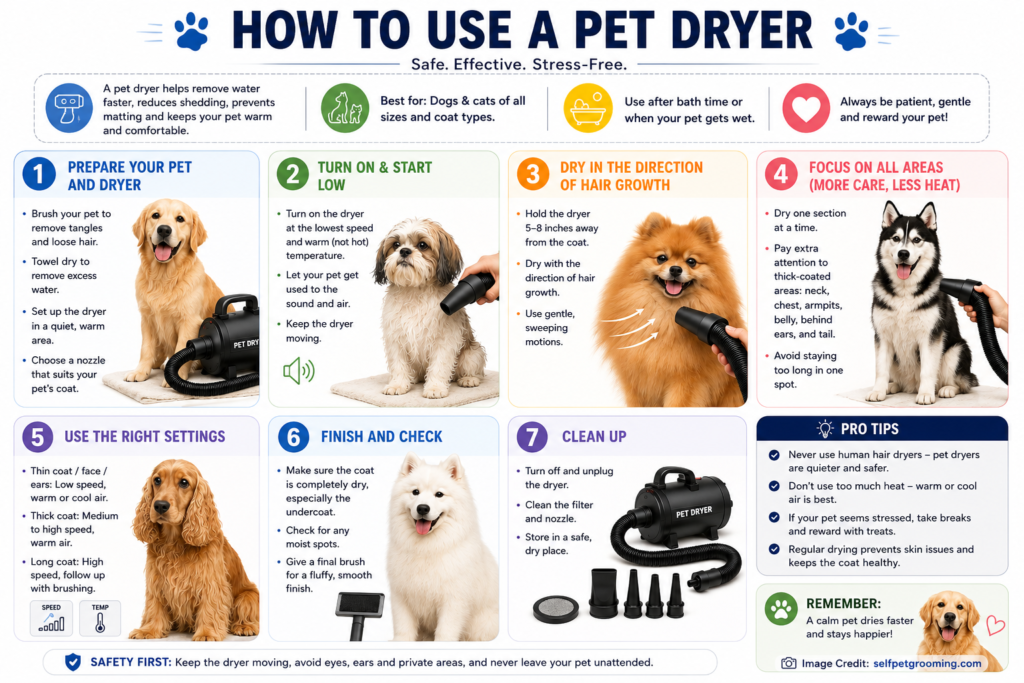
Step 1: First, towel-dry. Before the dryer is turned on, remove as much extra water as you can. This greatly reduces the overall drying time.
Step 2: Set the heat and speed to the lowest possible level. Before increasing the intensity, let the pet become accustomed to the tool, especially if it’s their first time using it.
Step 3: Maintain the nozzle’s motion while keeping a hand’s width away from the skin. Even on a “low” setting, it might be extremely hot to keep the airflow in one place for too long or too near.
Step 4: As you dry, brush. To stop loose undercoat from matting during the drying process, run a slicker brush or de-shedding tool through the coat.
Step 5: Work your way out to the extremes. The thickest parts of the coat, the torso and back, should be dried first, followed by the legs, tail, and face. Use the lowest setting and take extra care around the ears and eyes.
Step 6: Before stopping, examine the flesh as well as the coat. While the undercoat is still moist, the fur may seem and feel dry on the outside. To check, part the coat in a few places.
Common Mistakes
Going straight to the dryer instead of the towel-dry phase merely makes the procedure take longer. holding the drier too near for extended periods of time in one place, particularly on delicate parts like the ears or tummy.
hurrying through an initial introduction. A dryer should be introduced gradually, just like clippers; let your pet hear and feel it before committing to a full dry. Using the “high heat” setting on a human hair dryer on animal skin can be quite dangerous.
Is It Worth Adding to Your Kit?
A few towels and a little perseverance can be plenty if you’re only giving your pet infrequent baths. However, a dedicated pet dryer bridges one of the major gaps between do-it-yourself grooming and a complete salon-quality outcome if bathing, brushing, and trimming are becoming a regular part of your routine. It shortens the entire treatment, lowers the danger of matting, and for many pets, once they get acclimated to the sensation, it actually becomes one of the less unpleasant aspects of the procedure rather than the most stressful.
Do you use a pet drier at home, towel dry, or air dry? Share your routine in the comments.